
Support and documentation in Dutch
No language barrier during implementation, training or support.
Every organisation has at least one: a system that does not connect. A fifteen-year-old industry package, a government portal, a supplier environment, an accounting program that only exports through an Excel download.

Those systems are not bad, but they do stand on their own. Data that is in them has to be taken out by someone and put in somewhere else. By hand, every time.
That is the problem RPA solves. Not by replacing the system, but by putting a software bot on it that does exactly what an employee would do: log in, navigate, read, copy, fill in, save, send. The bot works at screen level (the user interface) and needs no API. It operates the system the way a person does, only faster, without errors and twenty-four hours a day.
Robotic Process Automation is not new, but its accessibility is. Where RPA used to be reserved for enterprise organisations with an in-house automation team and enterprise budgets, there are now platforms that put the same technology within reach of organisations of every size. Zoho RPA and Collabotics are the two platforms we use to do that.
Zoho RPA is Zoho's RPA platform, and it stands out on one point that is directly relevant to most Zoho users: it is not a standalone tool but an integrated part of the Zoho ecosystem.
At its core is a recorder-based bot builder. You carry out an action once (you click, type, navigate) and the platform records it as a reusable automation. For those who want more control, there is a visual drag-and-drop designer for building the steps by hand and adding logic.
What Zoho RPA offers:
Collabotics is a Dutch RPA platform built to enterprise security standards (including encrypted credential management, full logging of bot activity and an auditable execution history) and still accessible to mid-sized organisations that have no in-house automation team.
Mobile XL is the first and only official implementation partner of Collabotics in the Netherlands. That partnership is aimed at exactly those organisations: bigger than a start-up, smaller than a multinational, and ready to automate processes without the enterprise price tag that comes with the big RPA platforms.
Collabotics is strong in situations where compliance and security are not an afterthought. In sectors such as financial services, healthcare, government and education, requirements around access control, logging and GDPR are not recommendations but hard requirements. Collabotics was built with those requirements as its starting point.
Practical advantages for Dutch organisations:
No language barrier during implementation, training or support.
Relevant for GDPR and sector-specific requirements around data storage.
As the first implementation partner, we know the platform inside out. That means a shorter lead time, fewer unexpected bumps and a direct line to the platform.
Collabotics works at screen level, so it can be used with almost any system, including the industry-specific packages that have no API.
| Your situation | Likely choice |
|---|---|
| You already work with Zoho One or other Zoho apps | Zoho RPA |
| You want a low threshold and to pay for what you use | Zoho RPA |
| You have enterprise security requirements or sector rules | Collabotics |
| You work in a regulated sector | Collabotics |
| You want a Dutch implementation partner with support in Dutch | Collabotics |
| Both situations apply | We advise based on your specific situation |
| You are not sure which platform fits | We help you choose |
The choice is not always either/or. Some organisations use Collabotics for compliance-sensitive processes and Zoho RPA for the routine automations that fit seamlessly into the Zoho environment.
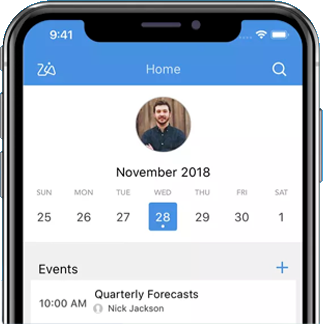
For organisations on Zoho One, Zoho RPA is part of the subscription. Request a trial environment and see for yourself how to build a first bot. We are happy to help you get started.
This is the combination that lifts automation from the routine to the exceptional.
RPA follows rules. That is both its strength and its limitation. A bot does exactly what you programmed it to do, the same way every time. As soon as interpretation is needed (reading an unstructured document, making a decision based on context, assessing an exception) RPA drops out.
AI agents fill exactly that gap.
Zia Agents are the AI agents that work within the Zoho environment and that you can use as an intelligent layer on top of your Zoho RPA bots. For Collabotics environments we connect external AI agents or language models to the automation process through APIs.
The combination of RPA and AI agents is known in the market as intelligent automation or hyperautomation, and it is the approach that lets you automate not only simple, repetitive processes but also the more complex exceptions that currently take up most of the manual time.
A digital worker operates applications through the screen, just like an employee, and carries out rule-based processes the same way every day. Combined with your existing business applications, this creates a chain in which data automatically ends up in the right place.
A customer moves, gets a new VAT number or changes contact person. A product gets a new price or is taken out of the range. Changes like these have to be made in several systems, including applications without an integration. The digital worker picks up the change from the CRM system or inventory management and applies it according to fixed rules in the accounting software, the webshop and the other applications. The integration platform makes sure the change reaches the digital worker straight away.
What it delivers
When a customer gets in touch, a service employee often has to gather information from different systems: the CRM, the accounts, a supplier portal or a management system. The digital worker does this as soon as a ticket comes into the service desk or a chat starts. It retrieves the relevant data, such as contract status, outstanding invoices, delivery status and previous faults. It adds that information to the ticket straight away, so the employee has the full picture immediately.
What it delivers
Many documents are waiting in external portals: policies at insurers, decisions at government bodies, reports at inspection bodies or invoices at suppliers. The digital worker periodically logs in to those portals, checks whether there are new documents and downloads them. It saves them in the right folder in the document management system and links them to the matching record in the CRM system or a custom application on the low-code platform. The responsible team gets a notification through the team chat.
What it delivers
Many portals and applications require extensive authentication, including two-factor authentication by email, text message or an authenticator app. That stops many organisations from automating those processes. The digital worker can go through these login procedures too, provided the required access is available. Login details are managed securely in a password manager and the rights of the digital worker are recorded in the identity and access management system, just like those of an employee.
What it delivers
Organisations want to benefit from digitalisation and AI, but at the same time keep a grip on compliance, data security and technological dependencies. That principle guides how our platform is designed.

We are the only partner in the Netherlands with certified knowledge of both Zoho RPA and Collabotics. That gives us a position most RPA partners do not have: we can advise independently on which platform suits your situation, instead of selling the one platform we happen to know.
Our automation knowledge goes beyond RPA alone. We know the integration layer: we build API integrations and work with integration platforms. We know the AI layer: we build Zia Agents and Creatio AI agents. And we know the process side: we carry out process mapping and guide BPM projects. That makes our advice on RPA different from a bot builder's: we start with the question of whether RPA is the right technology at all, and which part of the process is better served by an API integration, a workflow, an AI agent or a combination.
For many organisations that honest advice is the most valuable step. Buying RPA for a problem a simple API integration could solve more cheaply and more robustly is a common mistake.
We map the process as it really runs, including the exceptions. We decide which steps are suitable for a bot and which call for human judgement. You can also book a separate process mapping workshop to determine which processes are most suitable, with no obligation to implement.
Is RPA the right choice, or is an API integration more robust? Is an AI agent needed for the steps that vary? We give honest advice, even if the answer means less work for us.
We design the error handling and exception logic before we start building.
We build the bot on the chosen platform, test it on real data including the edge cases, and first let it run alongside the existing way of working.
We set up monitoring and alerting so errors are flagged before they affect customers or processes.
We hand over with documentation and agreements on who manages the bot, who makes changes and who is informed if something goes wrong.

Zoho RPA is optimised for organisations already working in the Zoho environment: usage-based pricing, native integration with Zoho apps and a recorder-based bot builder for quick implementation. Collabotics is built to enterprise security standards (including encrypted credential management, full logging and auditable execution), with pricing that also works for mid-sized organisations. For compliance-sensitive sectors Collabotics is usually the stronger choice; for Zoho environments Zoho RPA has the lowest threshold.
If a system has a usable API, a direct integration is almost always faster, more robust and cheaper to maintain. RPA is the choice when a system offers no usable API or import route: legacy software, government portals, supplier environments and industry packages that only have a user interface. The advice is always: API where you can, RPA where you must.
RPA carries out rule-based actions; AI agents add interpretation and judgement. A typical combination: the AI agent reads an unstructured document, extracts the relevant data and passes it to the RPA bot, which then updates the target system. With exceptions, the AI agent assesses whether the exception can be handled or needs to go to a person. Together they form intelligent automation: automation that can also deal with variation.
For a clearly scoped, well-documented process with few exceptions: a few days to a few weeks, depending on the complexity of the target system. Most of the time goes not into building but into capturing how the process really runs, including all the exceptions nobody had written down. If you start with a complex process, it takes longer.
A bot works at screen level, and when the screen changes the bot can break. Good bots are built with detection: they recognise when a screen is different from what they expect, stop, log the error and send an alert. The fix depends on what has changed: sometimes it is a small adjustment, sometimes a step needs rebuilding. At handover we agree who is responsible for catching and fixing this kind of situation.
That depends on which data the bot processes and how the bot is set up. A bot that reads, copies or writes personal data carries out automated processing you must be able to account for: on what legal basis, checked by whom, kept for how long, and who has access to the logs? Both Zoho RPA and Collabotics offer encrypted storage and logging. We include the GDPR questions in the bot design and help with the DPIA when one is required.
Yes, and that is one of the strongest arguments for RPA. A bot knows no office hours, no holidays and no sick days. You schedule it whenever suits best: at night when the load on systems is low, at the weekend when nobody is in the way, or continuously for processes that need to run in real time. The capacity is scalable: several instances of the same bot can run in parallel if the volume calls for it.
As many as you like, but start with one. Not the most complex, but the most obvious: high volume, clear rules, few exceptions, measurable time spent. Once that is in place, the next bot is easier, because you have already built up the platform, the management structure and the discipline of describing processes. We help you make that first choice based on the business case, not on technical complexity.
Mobile XL is the only partner in the Netherlands with certified knowledge of both Zoho RPA and Collabotics, with offices in Geleen and Utrecht.