

Which data goes to the model?
Decide what may and may not be shared, also with a view to the GDPR.
A lot is said about AI, and little of it helps you as a manager make a concrete decision. Should you invest in it? Where do you start? And what is the difference between a chatbot, an assistant and an agent?


In this article we focus on AI for business processes: the work that is currently done by hand in sales, marketing, customer support and management, and what AI can take over or improve.
We explain how AI works within Zoho and Creatio, the two platforms we work with. We cover Zia Agents, Creatio AI Agents, Zoho MCP and the connection with large language models (LLMs). The technology plays a supporting role. It always starts with the problem you want to solve.
AI for business processes means using artificial intelligence to support, speed up or take over work in your organisation. That goes further than a chat window where you ask questions. The value lies in AI that has access to your data and your processes.
You will come across three types.
AI delivers most where work is repetitive, where a lot of information comes together and where human judgement is only needed at the end. Those are exactly the areas where we help organisations.
Whether that works out the same way in your organisation depends on your processes and the quality of your data. We will come back to that further on.
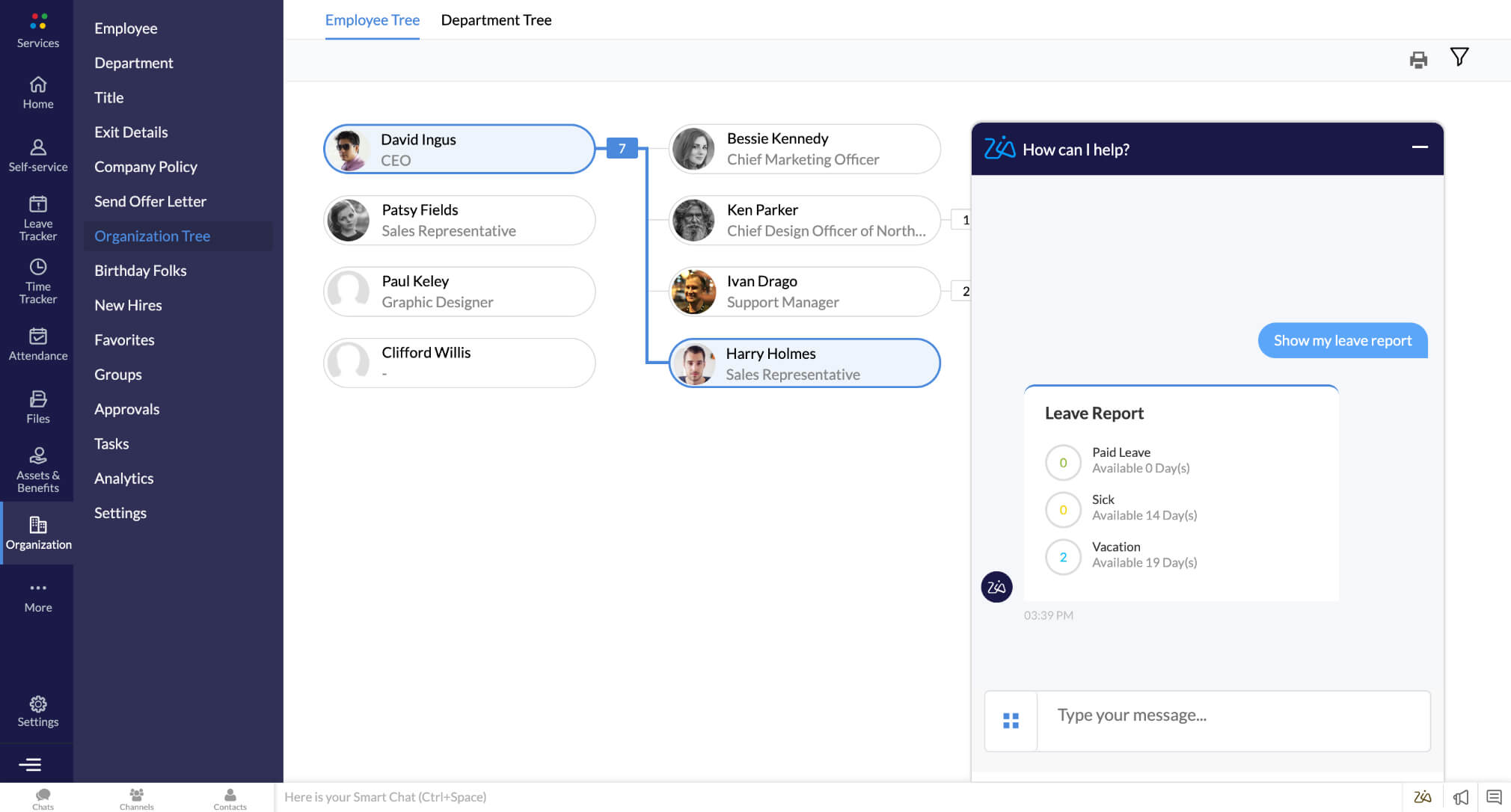
Zoho has been working with Zia, the platform's own AI layer, since 2015. Zia was launched as the core AI that makes intelligent and contextual actions possible across all Zoho apps. So you do not find Zia in a single package, but spread across the ecosystem.
An example from Zoho Desk: Zia works together with ChatGPT there and can, for example, recognise the tone of incoming tickets. That helps employees see more quickly which questions need attention.
Exactly which AI features you get differs per application, per plan and sometimes per region. That is why, for every customer, we first look at which options are available in your environment before we propose a route. That way you avoid making a plan around a feature that is not included in your licence.
With Zia Agents, Zoho goes a step beyond assistance. Zoho announced Zia Agents together with Agent Studio and Agent Marketplace.
Note the phasing. Zoho reported that the rollout started with a limited group of customers and will widen over time. So we always check in advance which agents you can use today.
Task-focused AI agents. Among others, Zoho showed an Account Manager Agent, SDR Agent, HR Agent, Customer Support Agent, IT Help Desk Agent and SalesCoach Agent.
An environment for building your own agents. It offers no-code and low-code experiences, which you use to create agents with skills that fit your situation.
The place where organisations can find, deploy and reuse specialised agents.
You call agents through Ask Zia. Agents with additional skills can be combined in Agent Studio into a single agent that works across functions. Zoho also indicates that agents will become usable in third-party applications in the future.
Creatio takes a different route: AI is at the core of the platform. The company calls itself an AI-native platform for CRM and workflows, in which people and AI agents work together.
What that means in practice:
MCP stands for Model Context Protocol, a standard that lets AI assistants connect securely to business applications. The Zoho MCP model gives AI assistants a standard way to connect to Zoho applications and understand the context.
This is interesting for you for a practical reason. Many employees already use an AI assistant such as Claude or ChatGPT. Through MCP, such an assistant can work with your Zoho data, within the permissions you set. With Zoho Mail, assistants get secure access to the APIs via OAuth 2.0. A description of the Desk version shows how you put together a server from Zoho Desk tools and point an assistant at it.
The result: you do not have to choose between "AI in Zoho" and "the AI we already use". You can have both work together. What your employees may then ask and have carried out, you decide in advance.
A connection with a large language model can be made in several ways. You can use the AI of Zoho or Creatio, connect your own model or API key, or link an external assistant via MCP. Which choice fits depends on three questions.
Technically, almost anything can be connected. The challenge lies in the agreements around it.
Decide what may and may not be shared, also with a view to the GDPR.
An assistant that can change data calls for stricter agreements than an assistant that only reads.
Use through your own subscription or API key comes with different costs than AI that is included in your platform licence. Put this on paper before you start.
AI projects rarely fail because of the technology. They fail because the problem was unclear or the data was not right. That is why we work in this order.
Not "introduce AI", but for example "following up enquiries costs our team too much time every week".
Where is time being lost? What exactly does an employee do now? A process workshop helps with this.
AI is only as good as the data it works with. Duplicate customer records and incomplete fields produce poor results.
Start with one agent or feature and measure what it delivers before you expand. Do you expect a certain saving? Then treat it as an assumption, not a certainty. Only after a first measurement period do you know what it delivers in your situation.
Let AI make suggestions where mistakes are expensive, and only later let it act on its own.
Decide who may do what and what happens to the data.
An agent nobody trusts will not be used.

Both platforms can help you, with different emphases. Zoho offers a broad ecosystem of applications with Zia as the connecting layer, which suits organisations that want many functions in one environment. Creatio is strong for process-driven organisations that place great value on workflows and an agent-focused approach. Read more on our pages about Zoho and Creatio.
We advise based on your situation, not on what we happen to prefer building. Sometimes a combination makes sense. Sometimes it turns out you need something else first, such as better integrations between your systems. If so, we will tell you.
Mobile XL automates and improves processes for organisations in the upper and middle segments of the SME market. We focus on the front of your organisation: sales, marketing, customer support and management.
The tool follows your process, not the other way round.
If AI is not the right solution, we should say so before you do.
Zoho internally, Creatio at customers, complemented by our own applications and integrations between applications.
AI changes quickly, and a setup that is right today will need a second look in a year's time.
For a long time AI was a catch-all term for us. Mobile XL showed us where it really adds something to our processes, and where it does not.

An assistant answers questions and makes suggestions. An agent also carries out tasks itself, in several steps, within the limits you set. Which tasks an agent may take over, you decide per process.
Zia Agents are Zoho's AI agents. There are ready-made agents for sales, customer support, HR and IT helpdesk, among others. You can also build your own agents with Zia Agent Studio. Availability differs per phase of the rollout, so we first check what is open for your environment.
Both are AI agents within a business platform. Zia Agents are part of the Zoho ecosystem. Creatio AI Agents are built into the Creatio platform for CRM and workflows. Which one fits depends on your processes and existing systems.
MCP is a standard that lets AI assistants connect securely to applications. Zoho MCP gives assistants such as Claude or ChatGPT a structured way to work with your Zoho data, within the permissions you set yourself.
That depends on how you set it up. Decide in advance which data may go to a language model, which permissions an agent gets and where data is processed. In Creatio, agents inherit the access rules from the role model. Also make agreements that fit the GDPR.
It helps enormously. AI works with your data, so duplicate records and missing fields lead to poor results. That is why, in a project, we look at the data structure first and only then at the agent.
That is not the goal of what we build. AI mainly takes over repetitive work, so employees have time left for work where judgement and customer contact count. Creatio says the same about its own agents: they work alongside your team.
Want to know where AI for business processes delivers most in your organisation? Then a first conversation is a good place to start. Together we look at your processes, your data and your current systems, and decide whether Zia Agents, Creatio, a connection via MCP or something else entirely is the best route. Honest and without obligation.